

 Aug 18, 2026
 8 min read
How Siraj-ud-Daula Lost the Battle of Plassey
Introduction
On the morning of 23 June 1757, in a mango grove beside the village of Palashi (anglicised as "Plassey") on the banks of the Bhagirathi river, a young Nawab of Bengal watched an army several times the size of his opponent's collapse into confusion and then flight. By evening, Siraj-ud-Daula's rule over one of the richest provinces in the Mughal Empire was effectively over. Within days he was dead, hunted down and executed on the orders of the man who replaced him.
Plassey is often remembered as a "battle," but in truth very little actual fighting took place. What decided the outcome was not gunpowder or cavalry charges — it was betrayal, engineered months in advance by the British East India Company in league with Siraj's own courtiers, generals, and bankers. To understand how the last independent Nawab of Bengal lost his throne in an afternoon, the story has to begin well before the armies ever met on the field.
Siraj-ud-Daula's Difficult Inheritance
Siraj-ud-Daula became Nawab of Bengal, Bihar, and Orissa in April 1756, succeeding his grandfather Alivardi Khan. He was young — not yet in his mid-twenties — and inherited a court riddled with rivals who had expected, or hoped, that power would pass elsewhere. His aunt Ghaseti Begum, the powerful banking house of the Jagat Seths, and several senior military commanders had all backed other claimants or simply distrusted him personally. Siraj moved quickly and harshly against these rivals, seizing Ghaseti Begum's wealth and alienating the Jagat Seths, whose financial network underpinned the entire Bengal economy. This was a serious miscalculation: in eighteenth-century Bengal, the Jagat Seths were not simply bankers but kingmakers, and humiliating them gave the Company's agents an eager and extraordinarily well-connected ally the moment they began looking for one.
At the same time, Siraj was alarmed by the British East India Company's growing fortifications at Fort William in Calcutta, built ostensibly against the French but which Siraj suspected — correctly — were also meant to secure a base of power independent of his authority. When the Company refused to stop building them, Siraj marched on Calcutta in June 1756 and captured it. The notorious and historically disputed "Black Hole of Calcutta" incident, in which a number of British prisoners died overnight in a cramped cell, followed this capture and became a powerful propaganda tool for the Company back in London and in Madras, where Robert Clive and Admiral Charles Watson assembled a force to retake the city.
The Company's Response and the Road to Conspiracy
Clive recaptured Calcutta in January 1757 and, rather than stopping there, moved against the French settlement at Chandannagar in March, further alarming Siraj about the scale of Company ambition in Bengal. But the more consequential campaign was not military — it was political. Clive and the Company's Calcutta Council, particularly William Watts, opened secret negotiations with a faction inside Siraj's own court that was ready to remove him.
The central figure in this conspiracy was Mir Jafar, Siraj's own Mir Bakhshi — commander of the Bengal army. Resentful and ambitious, Mir Jafar was drawn into a secret arrangement with the Company: if he stood aside, or actively worked against Siraj, during any confrontation with Company forces, he would be installed as the new Nawab in Siraj's place. The Jagat Seths, still smarting from Siraj's earlier treatment of them, helped broker and guarantee this arrangement, lending it the financial credibility the Company needed.
A treaty was drawn up promising Mir Jafar the throne in exchange for massive payments to the Company and its officials, and — in a detail that says a great deal about the ethics of the whole affair — a second, fake version of the treaty was shown to the Bengali intermediary Omichand, who had threatened to expose the plot unless he was paid a large commission. Clive personally authorised forging Admiral Watson's signature on the false document to deceive Omichand once his usefulness had ended. Other key commanders, including Yar Latif Khan and Rai Durlabh, were also quietly brought into the understanding that they would not fight to preserve Siraj's rule.
By the time Siraj marched his army toward Plassey to confront the advancing Company force, several of his most senior commanders had already agreed, in effect, not to fight for him.
The Battlefield at Plassey
On paper, the encounter should never have been close. Siraj's army numbered somewhere in the range of 35,000 to 50,000 men, including a large body of cavalry, war elephants, and a strong artillery train partly manned by French gunners under Monsieur Sinfray, who remained loyal to Siraj after the fall of Chandannagar. Clive's force was a fraction of that size — roughly 3,000 men, of whom only about 800 were European soldiers, the rest sepoys, supported by a modest number of field guns.
Clive was fully aware of how outnumbered he was, and by his own later account came close to calling off the engagement altogether, holding a council of war the night before to weigh retreat. What gave him confidence to proceed was his understanding, through Mir Jafar's secret assurances, that the bulk of Siraj's army would not actually fight.
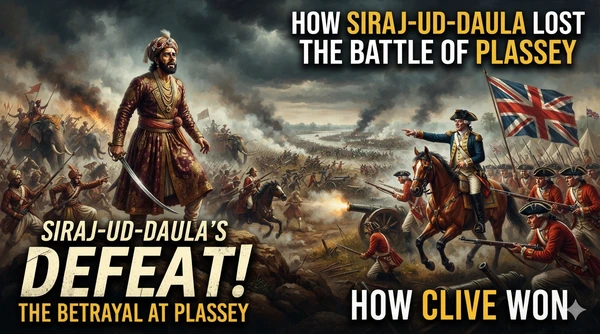
The battle opened on the morning of 23 June with an artillery exchange. A sudden, heavy monsoon downpour then struck the field. Clive's forces, more disciplined and better prepared, covered their ammunition and powder; Siraj's gunners largely did not, and much of their gunpowder was ruined. When the rain stopped and Siraj's artillery and cavalry resumed their advance believing the British guns had also been silenced, they were exposed to concentrated, still-functional Company fire and suffered heavy losses.
The most serious blow to Siraj's cause came with the death of Mir Madan, one of the few commanders who had remained genuinely loyal and who was leading the most committed portion of the assault. His death in the early afternoon, from artillery fire, threw the loyalist wing of the army into disorder at exactly the moment Siraj needed steady leadership. Shaken, and increasingly aware of how little control he had over the rest of his own command structure, Siraj turned to Mir Jafar for advice — the very man who had already agreed to betray him — and was counselled to withdraw his forces for the day. Mir Jafar's own contingent, along with those of Yar Latif Khan and Rai Durlabh, simply did not engage.
That withdrawal order was the actual moment of defeat. Once the retreat began, Clive's smaller force pressed the advantage, and what had been an orderly pullback collapsed into a rout. Siraj's camp was overrun; his army scattered. Company casualties for the entire day were remarkably light — a handful of killed and wounded — a lopsided outcome that reflects how little genuine fighting the larger, "loyal" portion of Siraj's army actually did.
Flight, Capture, and Death
Siraj-ud-Daula fled the field disguised, first back to his capital at Murshidabad and then further, attempting to escape to Patna. He was recognised and captured near Rajmahal by men loyal to Mir Jafar within days of the battle. Brought back to Murshidabad, he was executed on the night of 2–3 July 1757 on the orders of Mir Jafar's son, Miran, ending the independent Nawabi line that had governed Bengal.
Mir Jafar was installed as the new Nawab, exactly as promised, but as a Company client rather than an independent ruler in any meaningful sense. He was required to pay enormous sums to the Company and its officers — Clive among the largest personal beneficiaries — as reward for the arrangement, sums that badly strained Bengal's treasury and set a pattern of extraction that would deepen over the following decades.
Why He Really Lost
Stripped of the battlefield details, Siraj-ud-Daula's defeat at Plassey came down to a collapse of political trust, not military inferiority. He commanded, by a wide margin, the larger and better-equipped force. He lost because:
- He had alienated the financial and political elite of his own court, particularly the Jagat Seths, whose backing was essential to any Bengal ruler and who actively financed the conspiracy against him.
- His senior commanders had been bought or persuaded before the battle began, meaning the army that marched to Plassey was never as unified as its numbers suggested.
- He had no reliable way of testing his officers' loyalty in time, and by the point he recognised the danger — after Mir Madan's death — he had no alternative power base to fall back on.
- The Company exploited every one of these weaknesses systematically, through Clive's willingness to negotiate, bribe, and even forge documents to secure the outcome before a single shot was fired.
Plassey is remembered as the opening act of British political dominance in India, and it earns that reputation less because of what happened on the field on 23 June 1757 than because of what had already been arranged, quietly, in the months before it.
Sources and Further Reading
Accounts of Plassey draw heavily on contemporary and near-contemporary narratives, including Robert Clive's own correspondence and testimony, Robert Orme's History of the Military Transactions of the British Nation in Indostan, and Ghulam Hussain Khan's Seir Mutaqherin, an Indo-Persian history written within a generation of the events by an author with direct access to Bengal court circles. Modern historians treat all of these sources critically, since each carries the biases of its author — Company officials justifying their own conduct, and Bengali chroniclers writing under the rule of Siraj's successors.



Comments (0)
Leave a Reply
Log in to post a comment.