

 Aug 20, 2026
 8 min read
The Last War of Antiquity: How Rome and Persia Destroyed Each Other
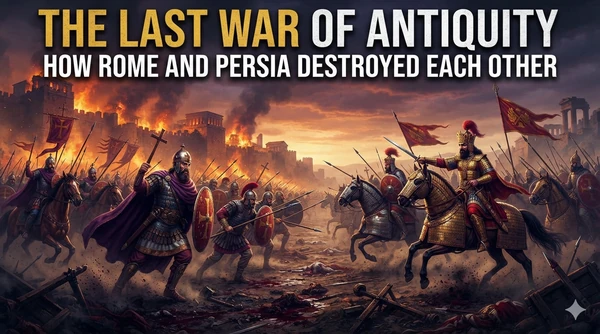
For nearly seven hundred years, two empires had faced each other across the deserts and mountains of the Near East. Rome — by the seventh century governed from Constantinople and speaking Greek — held the Mediterranean world. Persia, ruled by the Sasanian dynasty from its capital at Ctesiphon on the Tigris, held everything from Mesopotamia to the edge of India. They had fought each other under Trajan and Shapur, under Julian and Khusrow I. They had signed treaties, exchanged hostages, subsidised each other's border garrisons, and traded insults through ambassadors who were half diplomat and half spy.
None of those earlier wars had been fought for survival. The war that began in 602 was different. It ran for twenty-six years, reached the walls of Constantinople and the gates of Ctesiphon, and ended with both empires still standing but hollowed out. Within a decade of the peace, one of them had ceased to exist entirely and the other had lost more than half its territory.
It is one of history's clearest cases of a victory that cost more than defeat.
A murder in Constantinople
The war had a specific trigger, and it was a domestic one.
In 591, the Sasanian prince Khusrow II had been driven off his throne by a usurper and fled — remarkably — into Roman territory. The emperor Maurice took him in, lent him an army, and put him back on the Persian throne. In return, Rome received Persian Armenia and a long stretch of the contested frontier. For eleven years the two great powers were, improbably, allies. Khusrow called Maurice his father.
Then in 602 the Roman army on the Danube mutinied over pay and winter quarters. A junior officer named Phocas marched on Constantinople, seized power, and had Maurice executed — along with his sons, killed in front of him before his own turn came.
Khusrow declared war. He announced that he was avenging his benefactor and even produced a man claiming to be Maurice's surviving son Theodosius. Whether he believed any of this is doubtful. What he had was an unusually good pretext, a divided enemy, and a Roman frontier stripped of its best commanders by Phocas's purges.
The Persian tide
For the first decade, almost everything went Persia's way.
The frontier fortresses fell one after another — Dara, Amida, Edessa. In 613 the Persian army took Antioch, one of the great cities of the Roman East, and Damascus in the same campaigning season. In 614 they took Jerusalem after a siege of roughly three weeks. The city was sacked, a large number of its inhabitants were killed or deported, and the relic venerated as the True Cross was carried east to Ctesiphon as a trophy.
The psychological effect on the Roman world is difficult to overstate. Jerusalem was not simply a provincial city; its loss, and the loss of the Cross with it, was read across the empire as a divine verdict.
Egypt followed. Alexandria fell in 619, and with it the grain supply that had fed Constantinople for centuries. Persian forces pushed through Anatolia to Chalcedon, on the Asian shore of the Bosporus, close enough that the citizens of the capital could see their campfires across the water.
By around 620, Khusrow II ruled an empire approaching the extent of the old Achaemenid domain. The Roman Empire in the East had been reduced to Constantinople, the Aegean coastlands, a foothold in the Balkans under pressure from the Avars, and scattered holdings in the west.
It was at roughly this moment — the Roman low point — that the Qur'an addressed the conflict directly, in the opening verses of Sūrat al-Rūm: the Romans had been defeated in the nearest land, and after their defeat they would themselves be victorious, within a span of a few years. It is a rare instance of a scripture engaging with a contemporary geopolitical event in real time, and it tells us how closely the war was being followed far beyond the borders of either empire.
Heraclius
Phocas had been overthrown in 610 by Heraclius, the son of the exarch of Carthage, who sailed into the capital with a fleet and had his predecessor executed. He inherited a catastrophe. Sources report that he seriously considered abandoning Constantinople and moving the imperial government to Carthage, and was talked out of it.
What he did instead was rebuild the state around the war. He melted down church plate, with the Patriarch Sergius's consent, to pay the troops. He devalued the currency, cut official salaries, and reorganised the army's recruitment and command. He spent years training the field army personally in Anatolia rather than throwing it piecemeal against the Persians. And he reframed the war explicitly in religious terms — a campaign to recover the Cross, fought under sacred images, closer in tone to what later centuries would call a crusade than to a Roman frontier campaign.
In 622 he took the field. Rather than march east into Mesopotamia, where Persian strength was concentrated, he moved north through Armenia and the Caucasus, striking at the Persian heartland from an unexpected direction and forcing Khusrow's generals to chase him across difficult country. He wintered among the Caucasian principalities and negotiated an alliance with the Western Turkic Khaganate, whose horsemen joined the Romans in besieging Tiflis in 627.
626: the year the walls held
Khusrow's answer was to go for the capital itself.
In 626 a Persian army under Shahrbaraz occupied Chalcedon while an Avar khagan brought a large force of Avars, Slavs and subject peoples against the land walls of Constantinople from the European side. The plan required the two armies to combine. It failed on the water: the Roman navy controlled the Bosporus and destroyed the Slav boats attempting to ferry Persian troops across.
After weeks of assault the Avars withdrew. Constantinople's walls had held, as they would for another eight centuries. The siege became a foundational memory of the Byzantine state, commemorated in the hymn known as the Akathist and attributed by the city's inhabitants to the protection of the Theotokos.
Heraclius, meanwhile, had not come home to defend it. He had left the city to its walls and gone on campaigning in the east — a gamble that would have destroyed him had the walls given way.
Nineveh and the collapse
In late 627 Heraclius marched south into Mesopotamia with a relatively small, highly experienced force. On 12 December he met a Persian army near the ruins of Nineveh, on the Tigris. The battle was fought largely in fog. The Persian commander Rhahzadh was killed, reportedly in single combat with the emperor, and the Persian army broke.
Nothing now stood between Heraclius and Ctesiphon. He sacked Khusrow's palace at Dastagird, took its enormous accumulated treasure, and stopped short of assaulting the capital itself.
He did not need to. In February 628 Khusrow II was deposed by his own nobility and his son, who took the throne as Kavadh II, and was executed shortly afterwards. Kavadh sued for peace immediately. The terms were, on paper, generous to Rome: all occupied territory returned, all prisoners released, the True Cross restored. Heraclius carried it back to Jerusalem in 630.
He had won. He had recovered every province, avenged the humiliation of 614, and returned to Constantinople as the greatest Roman commander in three hundred years.
The cost
Kavadh II died of plague within months of taking the throne. What followed in Persia was four years of civil war, with a rapid succession of claimants — including two queens — before the boy king Yazdegerd III was installed in 632 over an empire that had lost its army, its treasury and its ruling consensus.
Rome was not much better off. The eastern provinces had been under foreign occupation for fifteen years and had just been reincorporated by an emperor who needed money urgently and whose religious policy alienated much of Syria and Egypt. The frontier client systems — the Arab federate confederations that had policed the desert edge for both empires — had lapsed, and subsidies to them had been cut.
In 636 a Roman army was destroyed at the Yarmuk. In the same period a Persian army was destroyed at al-Qādisiyyah. Within twenty years the Sasanian Empire had ceased to exist and Rome had lost Syria, Palestine, Egypt and North Africa permanently. Both had spent a generation and everything they had fighting each other, and neither had anything left when the next challenge came from a direction neither had been watching.
A note on the sources
The war is unusually well documented for its period, though every account carries an agenda. On the Roman side, the panegyrics of George of Pisidia were written for Heraclius's court; the Chronicon Paschale is close to events in Constantinople; Theophanes the Confessor, writing much later, preserves material from lost earlier chronicles. The Armenian history attributed to Sebeos gives a valuable non-Roman perspective from the Caucasus theatre. For the Persian side, and for the aftermath, the Arabic historians — al-Ṭabarī above all — preserve Sasanian court traditions that would otherwise be entirely lost.
Read together, they describe the same thing from four directions: the moment the ancient world ran out of strength.



Comments (0)
Leave a Reply
Log in to post a comment.