

 Jun 27, 2026
 16 min read
Derinkuyu and the Underground Cities of Cappadocia: Where Theory Meets Reality
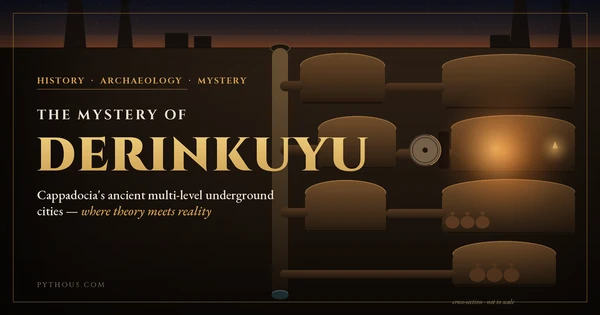
In 1963, a man in the central Turkish town of Derinkuyu took a sledgehammer to a wall in his house. Accounts of exactly what prompted it vary — one popular version has him chasing after chickens that kept vanishing into a crack in the masonry — but the result is not in dispute. Behind the wall lay a passage. The passage led to a room, the room to a stairway, and the stairway down into something nobody in the modern town had any idea was beneath their feet: a hand-carved city sunk eighty-odd metres into the rock, large enough to have hidden a small town's worth of people, their animals, and their food, all at once.
That city is Derinkuyu, and it is the most famous of dozens of underground settlements that riddle the volcanic plateau of Cappadocia. It is also one of those places where the documented facts are extraordinary enough on their own, yet the gaps in the record are wide enough to have attracted every kind of speculation, from sober archaeology to claims involving visitors from other planets. The honest way to write about it is to keep those two things apart: what the evidence actually supports, and what people have wished into the silences. So that is how we will go through it — the realities first, then the theories, and finally an honest accounting of what still isn't known.
What is actually down there
Start with the things that can be measured, because they are remarkable enough.
Derinkuyu descends to roughly 85 metres (about 280 feet) below the surface, which makes it the deepest excavated underground city in Turkey. Today, eight levels are open to visitors; the full complex is frequently described as reaching as many as eighteen, though the deeper sections are closed off for safety and have never been fully cleared. The footprint is enormous. Estimates of how many people it could shelter cluster around twenty thousand, together with their livestock and stores of grain, oil, and wine — and some researchers push the figure higher still when the neighbouring complexes that may once have connected to it are included.
This was not a mine or a set of storage cellars. It was designed for living. Excavations have turned up stables for animals, communal kitchens with soot-blackened ceilings, wine and oil presses, deep storage rooms, refectories where people ate together, wells for water, chapels, and even a large barrel-vaulted hall on the second level that is usually interpreted as a religious school. People could have stayed underground for weeks or months without surfacing, and at various points in history they almost certainly did.
Two features in particular tend to stop visitors in their tracks. The first is the ventilation. More than fifty shafts bore down through the rock, the deepest reaching some 55 metres, and they were engineered cleverly enough that fresh air reached the lowest occupied levels and cooking fires could be lit without choking the inhabitants. Those same shafts doubled as wells. A side effect of all that stone is a year-round temperature that sits at a steady 13–15°C, cool in the blistering Anatolian summer and mild when the surface is frozen.
The second is the doors. At intervals throughout the city, the builders carved enormous circular stones — discs roughly a metre or more across and weighing somewhere between two and five hundred kilograms — that could be rolled across a passage to seal it. Crucially, each one was designed to be operated only from the inside, and each level could be closed off independently. If attackers breached the entrance, defenders could fall back level by level, rolling the stones shut behind them and isolating any section that had been taken. A small hole through the centre of each door allowed the people behind it to see out, and, when necessary, to fight back.
Derinkuyu was also not alone. It is one node in a much larger pattern: surveys have catalogued well over two hundred underground settlements across Cappadocia, with later, more systematic counts running past three hundred and sixty. At least three dozen of these are substantial multi-level complexes. The nearby city of Kaymaklı is the widest of them, and tradition holds that the two were once joined by a tunnel running some eight or nine kilometres underground — a claim that is repeated everywhere but has never been fully confirmed along its whole length. Since 1985, the region's rock-cut heritage has been protected as part of a UNESCO World Heritage Site covering Göreme National Park and the Rock Sites of Cappadocia.
A machine for disappearing
It helps to think about what kind of problem an underground city solves, because the design answers a very specific question: how do you make an entire community vanish?
Cappadocia sat for millennia at a crossroads. Trade routes that fed into the Silk Road passed through it, which made it valuable, and being valuable in the ancient and medieval world meant being raided. Empires and armies came and went — Hittites, Phrygians, Persians, Greeks, Romans, Byzantines, Arab raiders, Seljuks, Mongols, Ottomans — and for the farming families who actually lived on the land, the safest response to an approaching column of soldiers was not to fight but to be gone before it arrived.
An underground city is the architecture of that strategy taken to its logical extreme. The entrances were small and easily hidden; from the surface, there was little to see. Livestock were generally kept on the upper levels, nearest the openings, where ventilation was best and the smell stayed away from the living quarters. The middle levels held homes, schools, chapels, and the spaces where wine and oil were pressed. The deepest levels were given over mostly to storage, where a constant cool temperature kept supplies from spoiling. Roberto Bixio, a speleologist who has spent years surveying Cappadocia's subterranean sites, has described the layout's logic plainly: beyond simply housing people, it allowed entire sections to be sealed and isolated, defenders to move between points, and counter-attacks to be organised through alternative passages. It was, in other words, a defensive system as much as a settlement — a place engineered so that a population could outlast a threat underground and re-emerge once the danger had passed.
Who carved it? The problem nobody has solved
Here is where the certainty runs out and the theories begin.
The trouble with dating Derinkuyu is fundamental: you cannot carbon-date a hole. Carving a chamber out of rock removes material rather than depositing it, and the objects later found inside a space don't necessarily tell you when that space was first cut — they tell you who was using it afterward. The city was also occupied and re-occupied across thousands of years, with each generation expanding and reshaping what it inherited. Untangling the original from the additions is genuinely hard, and reasonable specialists disagree.
The most widely accepted account, and the one endorsed by Turkey's Ministry of Culture and Tourism, credits the first excavations to the Phrygians, an Indo-European people who settled the region and are usually placed here in the 8th–7th centuries BC. The Phrygians were accomplished workers of stone, known for ambitious rock-cut monuments, and they had both the skill and the long presence in the area to begin a project like this. Under that reading, what they started as relatively simple dwellings was dramatically expanded much later, in the Roman and especially the Byzantine period, by the region's Greek-speaking Christian population, who added the chapels, the Greek inscriptions, and most of the depth. By that account Derinkuyu reached its mature form sometime between the 5th and 10th centuries AD.
A competing theory pushes the origin much further back, to the Hittites, the great Anatolian power of the second millennium BC. Some scholars — A. Bertini, a specialist in Mediterranean cave dwellings, among them — have suggested that the Hittites may have cut the first few levels, possibly while under pressure from Phrygian incursions around 1200 BC. A handful of artefacts of Hittite character have reportedly been recovered from the tunnels, which is the strongest thread this idea hangs on. But the evidence is thin and inconclusive, and a few stray objects could easily have arrived through later trade or reuse rather than original construction.
A third, much weaker proposal points to the Persians. It leans not on artefacts but on a text: a passage in the Vendidad, part of the Zoroastrian Avesta, describes the mythical king Yima building underground enclosures to shelter people and herds. The parallel is suggestive, but it names no real place and offers nothing physical to test, so it has never gained much traction among specialists.
What everyone does agree on is the earliest written reference. Around 370 BC the Greek soldier-historian Xenophon, in his account of a Greek army's long march across Anatolia known as the Anabasis, described people in the region living in houses dug into the ground. He pictured dwellings entered through a narrow opening like the mouth of a well, broad and roomy below, with separate tunnelled ramps for the animals while the people climbed down by ladder; inside, he wrote, were goats, sheep, cattle, and fowl, along with stores of grain and wine. Xenophon never names Derinkuyu, and his description fits the general practice of underground living in Cappadocia rather than any one site. But it confirms something important: by the fourth century BC, this way of life was already old and unremarkable enough for a passing soldier to jot it down. The underground cities were not a late medieval invention. Their roots run deep into antiquity, even if the exact first cut can't be pinned to a year.
The rock did half the work
Whatever hand first held the pick, none of this would have been possible without the ground itself, and the geology is the part of the story that is least mysterious and most decisive.
Cappadocia's landscape is the legacy of ancient volcanism. Eruptions from peaks such as Erciyes, Hasan Dağı, and Göllüdağ blanketed the region in thick layers of ash, which compacted over time into a soft rock called tuff (in places, ignimbrite). This is the same material that erosion has sculpted into the region's famous "fairy chimneys" — the tapering stone spires that draw photographers from around the world. Tuff has an unusual and very useful property: when freshly cut it is soft enough to be worked with simple hand tools, yet once exposed to air it hardens, so a carved chamber grows more stable rather than less. The local soil is also relatively dry, which means underground spaces tend not to flood or collapse from water seepage. As Andrea De Giorgi, a classical-studies scholar at Florida State University, has put it, the region's very geomorphology invites underground building; the rock practically asks to be dug.
This matters enormously for the question of how "advanced" the builders had to be. You do not need exotic technology, or outside help, to hollow out soft stone. You need time, organised labour, and a strong incentive — and Cappadocia's inhabitants had all three. The achievement is real, but it is a human achievement of patience and accumulated effort across many generations, not a one-off feat that strains belief.
A refuge used again and again
What gives Derinkuyu its peculiar weight is how long it stayed in service. This was not a city built, used briefly, and forgotten. It was a tool that the people of Cappadocia reached for, century after century, whenever the surface became dangerous.
During the Arab–Byzantine wars, roughly from the 7th and 8th centuries onward, Christian communities used the deep cities to ride out raids. Later, when the armies of the Mongol conqueror Timur swept through Anatolia in the 14th century, locals again went to ground; one old account even records a pursuer being killed by an arrow fired through the viewing hole of a sealed stone door. Under Ottoman rule the cities continued to serve as boltholes in times of trouble. And the practice survived into living memory: the Cambridge linguist Richard MacGillivray Dawkins, working among Cappadocia's Greek-speaking villagers in the years before the First World War, recorded that when news arrived of massacres at Adana in 1909, much of the population of one town fled underground and did not dare sleep above ground for several nights.
The end came not with a catastrophe but with a treaty. In 1923, following the war between Greece and Turkey, the two states agreed to a compulsory exchange of populations, and the Christian inhabitants of Cappadocia — the people who had maintained and used these cities for generations — were sent to Greece. The tunnels, no longer needed and no longer tended, fell silent. Forty years later, a sledgehammer and a missing chicken brought one of them back into the light.
The wilder theories — and why archaeologists set them aside
A place this strange, with a founding date this fuzzy, was always going to attract bolder explanations. They deserve to be taken seriously enough to actually examine, rather than just waved away — and when you examine them, they come apart.
The best-known belongs to the Swiss writer Erich von Däniken, famous for popularising the idea that ancient monuments were built with extraterrestrial help. Visiting Derinkuyu in the 1980s, he reasoned that a refuge this elaborate must have been protection against an attack "from the air," and from there suggested the involvement of visitors from beyond Earth. The argument collapses on its own logic. A city sealed from the inside with stones that can only be moved by the people hiding behind them is exactly what you would build to defend against raiders on foot and horseback — the threat the region demonstrably faced for thousands of years. Nothing about going underground implies an aerial enemy; in fact, hiding underground is a poor defence against anything that flies and an excellent one against soldiers who have to come in through a doorway you control. The "from the air" premise is simply asserted, not demonstrated, and once it's gone the rest of the theory has nothing to stand on.
A second family of claims casts Derinkuyu as a prehistoric doomsday bunker — built tens of thousands of years ago, sometimes the figure "12,000 years" is thrown around, to survive a great flood, a comet strike, an ice age, or some nameless cataclysm. These stories travel well online precisely because they can't be checked: they place the construction conveniently before any period for which we have records. But they run straight into the physical and textual evidence. There is no datable material anywhere in the complex that points to a Stone Age origin; the artefacts, inscriptions, and architectural features all belong to the Iron Age and later. Xenophon's fourth-century-BC account already describes the practice as ordinary, not as a relic of some vanished super-civilisation. And every single feature that's supposed to be inexplicable — the depth, the ventilation, the sealable doors, the storage — is fully explained by the mundane and well-documented need to hide from human armies. When a simple explanation accounts for all the evidence and a spectacular one accounts for none of it, the simple one wins.
It's worth being clear about why these theories are so persistent despite being so weak. They tend to rest on a hidden assumption that ancient or medieval people couldn't have managed something this impressive on their own. That assumption is both wrong and, frankly, a little insulting to the generations of Cappadocian farmers and masons who actually did the work. Underestimating the people of the past is the common root of nearly every "lost advanced civilisation" claim, and Derinkuyu is a textbook case. The real marvel here is not that aliens or Atlanteans were involved. It's that ordinary communities, working soft rock with hand tools over a very long time, built something that kept them alive through three thousand years of invasions.
What we still genuinely don't know
Dismissing the fantasies doesn't mean the case is closed. Plenty of real questions remain open, and intellectual honesty means naming them.
We don't know the precise date of the first excavation, and given the nature of the evidence we may never narrow it beyond "Iron Age, probably Phrygian, possibly with earlier beginnings." We don't know the full extent of the city, because significant portions remain unexcavated and sealed, whether for safety, preservation, or simple lack of resources. We don't know for certain that the celebrated tunnel to Kaymaklı ran continuously the whole way, or whether the "connection" is better understood as a network of nearby complexes that were linked in stretches. And across Cappadocia as a whole, new underground spaces are still being found — most dramatically the vast complex uncovered at Nevşehir in the 2010s during a housing project, which may rival or exceed Derinkuyu and is still being studied. The map of underground Cappadocia is not finished.
These are the kinds of gaps that real archaeology lives with: not invitations to invent a lost civilisation, but a frank to-do list for future excavation, surveying, and analysis. The mystery of Derinkuyu is genuine. It's just a different mystery than the one the sensational versions advertise — quieter, more patient, and ultimately more human.
Why it still grips us
Stand in one of Derinkuyu's chambers, eighty metres down, with the rock pressing in on every side and a single shaft carrying a thread of daylight from the surface, and the abstract facts become physical. Someone carved this by hand. Someone else cooked here, prayed here, pressed grapes here, and waited here in the dark for an army to pass overhead. Children went to school in the vaulted room on the second level. Families rolled a half-tonne stone across the passage and held their breath.
That, in the end, is what makes the underground cities of Cappadocia so hard to look away from. They are not a riddle about technology we've lost or knowledge beyond our reach. They are a monument to a very old and very human impulse — to survive, by whatever means the land allows — expressed on a scale that still astonishes. The theories about aliens and cataclysms make for a livelier headline, but the truth is the better story: that when the world above became unlivable, people simply built another one below, and kept it ready for three thousand years.
Sources and further reading
The dating and attribution of Derinkuyu remain debated; the references below represent the principal evidence and the range of scholarly and popular discussion, and are good starting points for going deeper.
- Xenophon, Anabasis (c. 370 BC). The earliest surviving written reference to underground dwellings in Anatolia/Cappadocia.
- Turkish Ministry of Culture and Tourism. Official attribution of the first excavations to the Phrygians (8th–7th century BC), with later Byzantine-era expansion.
- UNESCO World Heritage Centre — Göreme National Park and the Rock Sites of Cappadocia (inscribed 1985). Heritage status and description of the region's rock-cut sites.
- Roberto Bixio and the Centro Studi Sotterranei (Genoa). Speleological surveys of Cappadocia's underground cities and analysis of their defensive function.
- Andrea De Giorgi, Florida State University. Commentary on the geomorphology of Cappadocia and why its tuff is suited to underground excavation.
- A. Bertini. Scholarship advancing the hypothesis of early (possibly Hittite) excavation of the first levels.
- Richard MacGillivray Dawkins, Modern Greek in Asia Minor (1916). First-hand record of Cappadocian Greeks using the underground cities as refuge, including the 1909 Adana episode.
- Erich von Däniken (1980s). Source of the widely circulated "attack from the air"/extraterrestrial interpretation — included here as the origin of the fringe claims discussed above, not as a credible account.
- General overviews and site reporting: BBC Travel, History (history.com), HeritageDaily, and conference reporting on Derinkuyu's structure (e.g., WMCAUS, 2016).
Note on figures: depth (~85 m), the number of levels (8 open; up to ~18 reported), capacity (~20,000), and the count of underground settlements (200+ to 360+) vary between sources and surveys. Where sources differ, ranges have been given rather than a single contested number.


Comments (0)
Leave a Reply
Log in to post a comment.