

 Jun 27, 2026
 13 min read
Hazrat Abbas ibn Ali (a.s.): The Life and Martyrdom of the Alamdar of Karbala
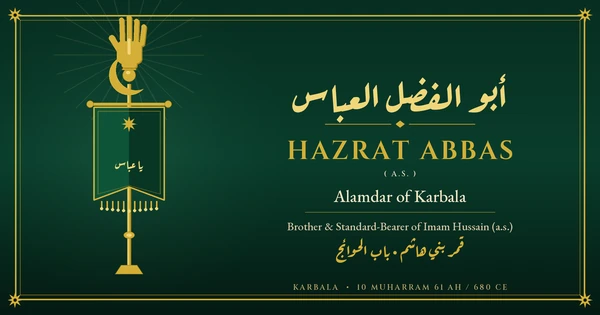
Of all the men who fell beside Imam Hussain (a.s.) at Karbala, the one the Muslim world has held closest is his younger brother, al-Abbas ibn Ali. People call him by many names. Mola Abbas. Ghazi Abbas. Qamar Bani Hashim, the moon of the Banu Hashim. Above all they call him Alamdar, the standard-bearer: the man who carried Hussain's banner into the field, and who chose to die of thirst on the bank of the Euphrates rather than drink a mouthful of water while the children of the Prophet's household went without.
What follows is his life from beginning to end. His birth in Medina, the mother chosen for her courage, the years in his father's house, and the last afternoon on the tenth of Muharram, 61 AH (October 680 CE). The account leans on the classical histories and the martyrdom literature that preserve what happened at Karbala.
A son of Ali, a brother of Hussain
Abbas came from the most honoured family in Islam. His father was Imam Ali ibn Abi Talib, cousin and son-in-law of the Prophet, fourth of the Rightly Guided Caliphs and the first Imam of the Shia. His mother was Fatima bint Hizam, of the tribe of Banu Kilab. On his father's side he was a Hashimite of Quraysh, which placed him inside the Prophet's own clan and made him brother to Hasan and Hussain, the grandsons of the Prophet and the sons of Fatima al-Zahra.
He was born in Medina, most sources say on the fourth of Sha'ban in the year 26 of the Hijra, around 647 CE. Abu al-Faraj al-Isfahani records his lineage in Maqatil al-Talibiyyin, and later biographers such as Sayyid Muhsin al-Amin gathered the reports together in A'yan al-Shi'a. From the start his world was the household of the Ahl al-Bayt, raised under a father who was the foremost scholar of his age and alongside two brothers who would define the rest of his life.
Umm al-Banin, a mother chosen for courage
His mother is part of the story and cannot be left out of it. After Fatima al-Zahra died, Imam Ali wanted to marry a woman who would bear him brave sons to stand beside Hasan and Hussain. He turned to his brother Aqil ibn Abi Talib, who was an authority on Arab genealogy, and asked him to find a wife from a line known for valour. Aqil pointed him to Fatima bint Hizam of the Banu Kilab, saying he knew of no ancestors among the Arabs braver than hers.
She bore Ali four sons: Abbas, Abdullah, Ja'far, and Uthman. All four were killed at Karbala. There are few details in the whole tragedy heavier than that one. A single mother gave four sons in a single day.
History remembers her not by her name but as Umm al-Banin, the mother of the sons. The reason is itself a measure of the woman. The tradition holds that she asked not to be called "Fatima," so that the orphaned children of al-Zahra would not have their mother's name spoken back to them and feel the wound reopen. She is said to have loved Hasan and Hussain more than her own children.
Growing up in the house of the Imamate
Abbas spent his early years in Medina, then in Kufa once his father took the caliphate and moved the seat of government there. He grew up, in other words, at the very centre of early Islamic learning and authority, watching his father govern, teach, and pray.
There is a much-loved story that places a young, masked Abbas at the Battle of Siffin in 37 AH, defeating seasoned warriors before Ali revealed to the crowd that the youth was his own son. Abbas would have been a boy of about eleven at the time, and historians treat the more dramatic versions with care. Still, the story carries something true about the reputation for courage that attached to him early, and about the household that raised him.
What the sources state plainly is the depth of his bond with Hussain. When Imam Ali was assassinated in Kufa in 40 AH, Abbas was around fourteen. He stayed in the household of the Imamate through the years of Imam Hasan, and after Hasan's death around 50 AH he gave himself entirely to the service of Hussain.
The moon of the Banu Hashim
The chroniclers describe Abbas as tall and strikingly handsome. The epithet Qamar Bani Hashim, the moon of the clan, came from the radiance of his face, and it is often said that he was so tall that his feet nearly touched the ground when he rode. But the sources are careful to add that his bearing matched his looks. He was a man of weight and dignity, not only a warrior of imposing build.
His kunya was Abu al-Fadl, after his son al-Fadl, and his line continued through another son, Ubaydullah. The rest of his titles came later, and each marks a part of him. Al-Saqqa and Abu al-Qirba, the water-bearer and the man of the water-skin, came from his efforts to carry water to the besieged camp. Alamdar and Hamil al-Liwa name the banner he held. Ghazi names the warrior. And Bab al-Hawaij, the gate of needs, is the name his devotees still use when they turn to him in prayer.
Loyalty before everything
What raised Abbas above the role of a brave brother was the way he saw Hussain. He treated him not only as a sibling but as his Imam and the rightful leader of the community, addressing him as "my master" rather than simply by name. The strongest man in the camp made himself its most obedient. Everything he was, his strength, his standing, his sword, he placed under Hussain's command. In the final hours that loyalty would be tested past any reasonable limit, and it held.
Leaving Medina
In the year 60 AH, Mu'awiya died and his son Yazid demanded the oath of allegiance from Hussain. Hussain refused to pledge himself to a ruler he considered corrupt, and to keep blood from being shed in the sacred city he left Medina for Mecca in the late summer of that year. Abbas went with him.
Letters then poured in from Kufa, inviting Hussain to come and lead. He sent his cousin Muslim ibn Aqil ahead as his representative, and set out from Mecca toward Kufa on the eighth of Dhu al-Hijja. Through all of it, Abbas rode as the bearer of his brother's standard, the visible sign of the Prophet's house on the move.
Karbala
Yazid's forces intercepted the caravan and steered it off the road to Kufa, and on the second of Muharram, 61 AH, Hussain and his people made camp on the plain of Karbala beside the Euphrates. The next day the army of Umar ibn Sa'd, sent by the governor of Kufa, Ubaydullah ibn Ziyad, arrived to surround them. Hussain had with him only some seventy-two fighting men. Against them stood thousands. Al-Tabari and Shaykh al-Mufid preserve the days of pressure and failed negotiation that followed, as Ibn Ziyad held out for nothing less than Hussain's surrender.
A detail the sources record here is telling. Because Abbas and his brothers belonged through their mother to the Banu Kilab, the Umayyad commander Shimr secured a letter of safe conduct for them from Ibn Ziyad. They could have walked away alive. According to the early historian Abu Mikhnaf, they refused it, saying that God's protection was better than the protection of the son of Sumayya.
Cut off from the river
Around the seventh of Muharram, Ibn Ziyad ordered the camp cut off from the water entirely and posted horsemen along the Euphrates. The children, the women, and the men were left to thirst under the desert sun in the last days before Ashura.
This is where Abbas first became al-Saqqa in earnest. The histories record a night raid in which he led a party down to the river, in some accounts alongside the loyal companion Nafi' ibn Hilal, broke through the guard, and brought water-skins back to the camp. Even with that effort, the people of the camp went thirsty for days. The episode is a quieter rehearsal of the one that would end his life.
The night before Ashura
On the eve of the tenth, Hussain gathered his family and companions and released them all from any duty to him. In one of the most moving scenes in the whole account, preserved by al-Mufid, al-Tabari, and Ibn al-Athir, he is said to have had the lamps put out so that anyone who wished to slip away in the dark could do so without shame. The enemy, he told them, wanted him alone.
No one left. Each man rose to say he would not abandon him. Tradition holds that Abbas was the first to answer, swearing he would never live to see the day his Imam was killed. The camp turned to prayer and the Qur'an and waited for the light.
The morning of the tenth
When the sun came up, the lines were drawn. Hussain handed the standard of the army to Abbas, the highest trust he could give, confirming him as the commander of his right wing.
Then the killing began. One after another the companions went out and fell, and then the young men of the Prophet's house. Among them, the sources say, were Abbas's own brothers, the other sons of Umm al-Banin, who died in front of him. He bore it and kept his place.
The walk to the water
As the day wore on, the cries of the thirsting children, among them Sakina, Hussain's small daughter, grew unbearable. Abbas could not stand it. He went to his brother and asked leave to bring water from the river.
He took up a water-skin and his standard, mounted, and drove toward the Euphrates. He broke through the guard at the bank and reached the water. What happened next is the moment his whole memory turns on. Burning with a thirst of his own after days without a drink, he scooped a handful of water and lifted it toward his mouth. Then he remembered that Hussain and the children were still parched in the camp, and he let the water fall back into the river. He would not drink before them. The martyrdom narratives preserve words attributed to him in that instant, to the effect that he could not bring himself to taste cool water while Hussain thirsted, and that doing so would betray his faith.
He filled the skin and turned back toward the tents, thinking of nothing but the water.
The fall of the standard-bearer
On the way back they ambushed him in the palm grove. The accounts in al-Khwarizmi's Maqtal al-Husayn, Ibn Tawus's al-Luhuf, and the later compilation of Shaykh Abbas al-Qummi set down the sequence that has been recited and wept over ever since.
A blow took off his right hand. He shifted the skin and the standard to his left and went on, reciting verses that he would defend his religion and his Imam even without his hand. Then his left hand was cut away too. Refusing still to give up the water, he held on as best he could, until an arrow pierced the water-skin and the water he had fought for ran out into the sand.
An arrow then struck his eye, and an iron mace came down on his head, and Abbas fell from his horse. As he lay dying he called out the line that every gathering of mourning still repeats: "Ya akha, adrik akhak." O my brother, come to your brother.
"Now my back is broken"
Hussain reached him and found him gone, his hands severed and the skin empty. The words he is reported to have spoken mark the breaking point of the entire tragedy: "Al-ana inkasara zahri." Now my back is broken, and what little choice I had has grown less.
The sources note something that sets Abbas apart from the other martyrs. Hussain did not carry his body back to the camp as he did the others. The tradition offers reasons. Some say the wounds were too terrible to bring before the women and children. Some say Abbas himself had asked not to be taken to the tents, so that Sakina would not see him fallen. Either way, he was buried where he died, apart from the rest.
Buried where he fell
That grave became the shrine of Abbas ibn Ali in Karbala, with its golden dome, standing a short distance from the shrine of Imam Hussain. The open ground between the two is known to pilgrims as Bayn al-Haramayn, between the two sanctuaries. Millions visit each year, above all during Muharram and the Arba'een, the fortieth-day pilgrimage. The faithful recite the special ziyarat of Abbas, and many call on him as Bab al-Hawaij when they bring their needs.
What the alam still means
His memory lives well beyond the page. In the mourning traditions, especially across South Asia, the alam, the standard he carried, often topped with the open hand, is raised in processions as a living emblem of what he did. The cutting of his hands and the spilling of the water are told again every year in elegy and sermon. His last act folded a whole ethic into a single gesture: a man dying of thirst, water in his cupped hands, who would not drink before those he served.
Why he is remembered
It is worth asking what people have found in him for fourteen centuries. Part of it is the refusal at the river. Part of it is the night before Ashura, when he was handed a way out and did not take it, because loyalty is easy to say and hard to prove, and he proved it at the only moment that counted. And part of it is the shape of the whole life: the strongest man in the camp made himself the most obedient, putting his strength entirely behind someone he could have rivalled. He carried the deaths of his brothers, the loss of both arms, and his own death with words of faith rather than a single word of complaint. That is the figure the elegies return to every Muharram.
Sources
The narrative above rests on the main early histories and the martyrdom literature of Karbala, with the biographical compilations filling in the life around it. For primary material, see:
- al-Tabari, Tarikh al-Rusul wa'l-Muluk — the foundational early history for the events of 60 to 61 AH.
- Shaykh al-Mufid, Kitab al-Irshad — a detailed early account of Hussain's uprising and the day of Ashura.
- Abu al-Faraj al-Isfahani, Maqatil al-Talibiyyin — biographies of the martyred descendants of Abu Talib.
- Ibn al-Athir, al-Kamil fi'l-Tarikh — a broad history that corroborates the sequence at Karbala.
- Sayyid Ibn Tawus, al-Luhuf ala Qatla al-Tufuf — a classic devotional maqtal of the tragedy.
- al-Khwarizmi, Maqtal al-Husayn — an early and influential martyrdom narrative.
- Sayyid Muhsin al-Amin, A'yan al-Shi'a — a major modern biographical encyclopedia, with a long entry on Abbas.
- Shaykh Abbas al-Qummi, Nafas al-Mahmum and Muntaha al-Amal — widely read compilations of the Karbala story.
A note on the sources
Karbala is preserved in two registers, the historical chronicle and the devotional maqtal, and an honest account should say so. The early histories, al-Tabari and Ibn al-Athir chief among them, fix the broad sequence of events. Many of the most beloved details around Abbas, his exact words at the river, the verses on his lips, the precise manner of his fall, reach us through the later maqtal and biographical literature and the living tradition of remembrance. It is also worth noting that some chains of transmission are debated among scholars, and that a number of the more elaborate figures and feats attributed to him in popular retellings are later embellishments. None of that diminishes him. As more than one scholar has observed, Abbas never needed exaggeration in order to be loved.
Peace be upon Abu al-Fadl al-Abbas, the loyal, the standard-bearer, the moon of the Banu Hashim, and upon all the martyrs of Karbala.

Comments (0)
Leave a Reply
Log in to post a comment.