

 Jun 25, 2026
 15 min read
Imam Hussain (a.s.): His Life, the Stand at Karbala, and the Message That Outlived an Empire
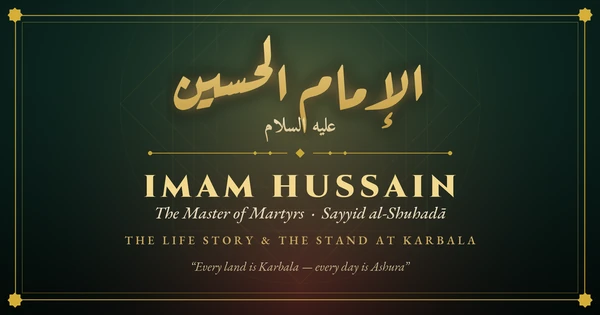
"Hussain is from me, and I am from Hussain." — The Prophet Muhammad (peace be upon him and his family), narrated in Sunan al-Tirmidhi and Sunan Ibn Majah.
Few names in human history carry the weight of Imam Hussain ibn Ali ibn Abi Talib (a.s.). Grandson of the Prophet Muhammad (pbuh), son of Imam Ali (a.s.) and Fatima al-Zahra (a.s.), and the third Imam of the Ahl al-Bayt, Hussain is remembered not merely as a figure of the past but as a living principle: that truth, dignity, and justice are worth every sacrifice. His stand at Karbala in 61 AH (680 CE) became the moral axis around which countless movements for freedom have turned ever since.
This article traces his life in detail — from his childhood in the household of revelation, through the turbulent years after his father and brother, to his role as the foremost defender of Islam's conscience, and finally to the tragedy and triumph of Karbala and the message it left for all time.
A note on abbreviations: (pbuh) = peace be upon him and his family, used for the Prophet; (a.s.) = ʿalayhi/ʿalayhā al-salām (peace be upon him/her), used for the Imams and the Ahl al-Bayt.
1. Childhood: Born in the House of Revelation
Lineage and birth
Imam Hussain was born in Medina on the 3rd of Shaʿbān, 4 AH (corresponding to 626 CE), though some historians record the 5th of Shaʿbān. His lineage is among the most honoured in Islam:
- Father: Imam Ali ibn Abi Talib (a.s.), cousin of the Prophet, first male to accept Islam, and fourth caliph.
- Mother: Fatima al-Zahra (a.s.), the beloved daughter of the Prophet Muhammad (pbuh).
- Grandfather: The Prophet Muhammad (pbuh) himself.
- Elder brother: Imam Hasan (a.s.), the second Imam.
It was the Prophet who named him. According to widely transmitted reports, when Hussain was born the Prophet recited the call to prayer (adhān) in his ear, named him "Hussain" (a name said to have had no precedent in pre-Islamic Arabia), and performed the customary rites for a newborn (Shaykh al-Mufid, al-Irshad; al-Tabari, Tarikh).
The Prophet's profound love
The bond between the Prophet and his two grandsons is documented across both major hadith traditions. The Prophet is reported to have said:
"Al-Hasan and al-Hussain are the two masters of the youth of Paradise." (Sunan al-Tirmidhi)
He would carry them on his shoulders, interrupt his prostration in prayer when the young Hussain climbed onto his back, and declare openly his affection for them. Companions narrate scenes of the Prophet kissing Hussain and saying that whoever loved Hussain loved him, and whoever loved him was loved by God (Sunan Ibn Majah; Musnad Ahmad).
Among the People of the Cloak
Hussain's childhood unfolded at the very centre of Islam's spiritual life. He was one of the Ahl al-Kisa — the "People of the Cloak" — when the Prophet gathered Ali, Fatima, Hasan and Hussain beneath his mantle. In connection with this, Muslim exegetes link the Verse of Purification:
"Indeed, Allah desires to remove all impurity from you, O People of the Household, and to purify you with a thorough purification." (Qur'an 33:33)
He was also present, as a child, at the event of the Mubahala (Qur'an 3:61), when the Prophet, challenged by a Christian delegation from Najran, brought forward Hasan and Hussain as "our sons," Fatima as "our women," and Ali as "our selves." That a small child was chosen to stand in this sacred confrontation speaks volumes about his standing in the household of prophecy.
A foretold destiny
Several narrations record that the Prophet wept over the infant Hussain, foretelling that his grandson would one day be killed by a faction of the Muslim community, and that the very soil of the land where he would fall (Karbala) was shown to him (narrated via Umm Salama and others in Musnad Ahmad and later collections). Thus, from his earliest days, Hussain's life was framed by both immense love and a solemn destiny.
2. After Imam Ali (a.s.): The Years of Trial
Loss after loss
Hussain was still a young man when the foundational figures of his life departed in close succession: the Prophet (in 11 AH), and then his mother Fatima al-Zahra (a.s.) only months later. He grew into adulthood during the caliphates that followed, witnessing the rapid expansion of the Muslim state and the political tensions that accompanied it.
When his father Imam Ali (a.s.) became caliph (35 AH), Hussain stood beside him through the trials of that period, including the conflicts at the Battles of the Camel and Siffin. He was, throughout, a steadfast supporter of his father's vision of just governance rooted in the Qur'an and the Prophet's example.
The martyrdom of Imam Ali
In Ramadan of 40 AH (661 CE), Imam Ali was struck down in the mosque of Kufa and martyred. Leadership of the Ahl al-Bayt passed to Hussain's elder brother, Imam Hasan (a.s.).
The peace treaty of Imam Hasan
Facing the military and political power of Muʿawiya ibn Abi Sufyan, and seeking to prevent bloodshed within the Muslim community, Imam Hasan concluded a peace treaty with Muʿawiya around 41 AH. Among its widely reported conditions were that Muʿawiya would govern by the Book of God and the Sunnah, would not appoint a successor (leaving the matter to consultation), and would protect the followers of Ali. Hussain accepted his brother's decision, recognising it as a strategic act to preserve the community and the faith.
For roughly the next two decades, Hussain lived under Muʿawiya's rule, largely based in Medina. After Imam Hasan was poisoned and martyred (commonly dated to 50 AH / 670 CE), Hussain became the third Imam and the central figure of the Prophet's household — a position of immense moral authority, even without political power.
3. Defender of Islam: Knowledge, Worship, and Conscience
Long before Karbala, Hussain was recognised as a guardian of Islam's deepest values. His "defense of Islam" was not only the sword of Karbala but a lifetime of upholding the faith's integrity.
A man of knowledge and worship
Hussain was renowned for his devotion. Reports describe his long nights of prayer, his frequent fasting, and his many pilgrimages to Mecca — some narrations say he performed Hajj on foot. The supplication attributed to him known as Duʿa ʿArafa, recited on the plain of Arafat, remains one of the most profound texts of Islamic spirituality, weaving together gratitude, humility, and love of God.
Generosity and care for the vulnerable
Like his father, Hussain was celebrated for his generosity. Historical anecdotes recount him freeing servants for acts of kindness, settling the debts of the poor, and carrying provisions at night to widows and orphans — burdens that left marks on his back, discovered only after his death. He embodied the Qur'anic ethic of caring for the orphan, the needy, and the traveller.
A voice against injustice
Hussain understood the Imam's role as protecting the substance of religion, not merely its outward form. As the rule of the Umayyads drifted further from prophetic norms — with growing worldliness, the public cursing of Imam Ali in some quarters, and the erosion of consultative governance — Hussain became a reference point for those who longed for justice. He counselled patience during his brother's treaty and Muʿawiya's lifetime, but he never surrendered the principle that legitimacy belongs to truth, not to force.
This is the man who would soon be confronted with the demand that would define his legacy.
4. Waqia Karbala: The Stand That Shook History
The accession of Yazid
When Muʿawiya died in 60 AH (680 CE), he was succeeded by his son Yazid — in violation, by many accounts, of the earlier understanding that the succession would not be made hereditary. Yazid's character and conduct were, in the eyes of Hussain and many others, incompatible with the office of leading the Muslim community.
Yazid moved quickly to demand the bayʿah (oath of allegiance) of prominent figures in Medina, Hussain foremost among them. To pledge allegiance to Yazid would mean, in Hussain's view, lending the authority of the Prophet's own grandson to a rule that betrayed everything the Prophet had stood for.
"A man like me does not pledge to a man like him"
Hussain refused. In words preserved in the early sources, he made his stand a matter of principle, declaring that someone like him could not give allegiance to someone like Yazid, and that he had risen not for power, corruption, or oppression, but to reform the community of his grandfather, to enjoin good and forbid evil (al-Tabari, Tarikh; Sayyid ibn Tawus, al-Luhuf).
To avoid an immediate confrontation in Medina, Hussain left for Mecca in Rajab/Shaʿbān 60 AH, seeking the sanctuary of the holy city.
The letters from Kufa
In Mecca, Hussain received a flood of letters from the people of Kufa — thousands of them — pledging support and imploring him to come and lead them against Umayyad rule. They wrote that they had no rightful Imam and begged him to unite them upon truth.
Hussain dispatched his cousin and trusted envoy, Muslim ibn ʿAqil, to Kufa to assess the situation and take the people's pledge on his behalf. At first, Muslim was met with overwhelming support — tens of thousands reportedly pledged allegiance.
Betrayal in Kufa
The Umayyad response was swift and ruthless. Yazid appointed ʿUbaydullah ibn Ziyad as governor of Kufa, who deployed threats, bribery, and terror to break the people's resolve. The crowds melted away. Muslim ibn ʿAqil was abandoned, captured, and martyred (9 Dhul-Hijjah 60 AH), as was his host, Hani ibn ʿUrwa. The Kufa that had invited Hussain would, within weeks, become the base of the army sent against him.
The journey toward Karbala
Hussain, having already set out from Mecca on 8 Dhul-Hijjah 60 AH (the Day of Tarwiyah) — pointedly leaving before completing the Hajj, lest the sanctity of the pilgrimage be violated by an attempt on his life — travelled with his family and a small band of loyal companions toward Iraq. Along the way he learned of Muslim's death, yet he continued, understanding that his stand had become larger than any single city's loyalty.
His caravan was intercepted by an Umayyad cavalry detachment under Hurr ibn Yazid al-Riyahi, which shadowed and steered the group until it was forced to halt at a desolate plain by the Euphrates — a place called Karbala — on the 2nd of Muharram, 61 AH.
The siege and the blockade of water
The Umayyad army, eventually numbering in the thousands and commanded by ʿUmar ibn Saʿd under orders from Ibn Ziyad, surrounded Hussain's camp of roughly 72 companions and family members, including women and children. From around the 7th of Muharram, they cut off access to the water of the Euphrates, subjecting the camp — including infants — to burning thirst in the days before Ashura.
Negotiations continued. Hussain was offered one path to survival: submit and pledge allegiance to Yazid. He refused. He is reported to have offered to withdraw rather than fight, but Ibn Ziyad's orders left no room for honourable compromise: allegiance or the sword.
The Night of Ashura
On the eve of the 10th of Muharram, knowing that battle was certain, Hussain gathered his companions. In one of the most moving scenes in the sources, he released them all from any obligation to stay, telling them the enemy wanted only him, and that they were free to leave under cover of darkness. Not one abandoned him. His companions and family declared they would never outlive him.
That night, the camp spent its final hours in prayer, recitation of the Qur'an, and worship — the sound of supplication rising like the hum of bees, as one narration describes it.
The Day of Ashura — 10 Muharram 61 AH
At dawn on Ashura, the 10th of Muharram 61 AH (October 680 CE), Hussain arranged his tiny band against an overwhelming force. Among those who stood and fell that day were some of the most luminous names in the history of the Ahl al-Bayt:
- Al-ʿAbbas ibn Ali (a.s.) — Hussain's devoted half-brother and standard-bearer, who fell while attempting to bring water to the thirsting children, earning the title Bab al-Hawaij ("Gate of Needs") in later devotion.
- Ali al-Akbar (a.s.) — Hussain's eldest son, said to resemble the Prophet most closely in face, voice, and manner.
- Al-Qasim ibn Hasan (a.s.) — the young nephew of Hussain.
- ʿAli al-Asghar — Hussain's infant son, killed by an arrow as Hussain held him, pleading for water.
- Loyal companions such as Habib ibn Mazahir, Zuhayr ibn Qayn, Muslim ibn ʿAwsaja, and others — and Hurr ibn Yazid al-Riyahi, the very commander who had first blocked Hussain's path, who repented at the last moment, crossed the lines, and died fighting for him.
One by one, Hussain carried the bodies of his companions and loved ones back to the tents. Then, alone, wounded, and grief-stricken, the grandson of the Prophet faced the army.
The martyrdom
In the afternoon of Ashura, Imam Hussain (a.s.) was martyred — surrounded, cut down by many hands, his body bearing countless wounds. He was about 56 or 57 years old. The sources record that even in his final moments, he turned to God in submission. The tragedy did not end with his death: the camp was overrun, the tents set ablaze, and the survivors taken captive (al-Tabari, Tarikh; Abu Mikhnaf, Maqtal al-Husayn; Shaykh al-Mufid, al-Irshad; Abu'l-Faraj al-Isfahani, Maqatil al-Talibiyyin).
The aftermath: the captives who carried the message
What the swords of Karbala could not silence, the voices of the survivors carried across the empire. The women and children — led by Hussain's heroic sister Sayyida Zaynab (a.s.) and his ailing son Imam Ali Zayn al-ʿAbidin (a.s.) (also called al-Sajjad), who survived because illness had kept him from the battlefield — were marched as prisoners to Kufa and then to Yazid's court in Damascus (Sham).
There, in the courts of their oppressors, Zaynab and Imam Sajjad delivered sermons that turned the Umayyad "victory" into a moral catastrophe for the regime. Zaynab's defiant address before Yazid — exposing the crime, defending the honour of the Ahl al-Bayt, and predicting that history would never forget — transformed captivity into testimony. It was, in a sense, the second half of Karbala: the battlefield secured the sacrifice; the captives secured its meaning.
5. The Final Message: Why Karbala Never Dies
Imam Hussain's stand was never about seizing a throne. He went to Karbala vastly outnumbered, with his family beside him, knowing the likely outcome. This is precisely why his sacrifice resonates: it was a deliberate choice of principled death over a dishonourable life.
The heart of his message
A few themes shine through every reliable account of his life and stand:
- Truth over tyranny. Hussain refused to legitimise injustice, even when refusal meant death. He drew a permanent line between conscience and coercion.
- Dignity and freedom. Among his reported sayings on that day: that he would face death with honour rather than submit to humiliation — "Death with dignity is better than a life of humiliation."
- Reform, not rebellion for power. He framed his rising explicitly as amr bil-maʿruf wa nahy ʿan al-munkar — enjoining good and forbidding evil — to revive the community of his grandfather.
- Sacrifice as awakening. By giving everything, Hussain shook a sleeping community awake. His blood, in the imagery of later tradition, watered the roots of justice for generations.
"Every day is Ashura, every land is Karbala"
This enduring maxim captures how Hussain's stand transcends a single date and place. It became a template for resistance against oppression wherever it is found — a reminder that the choice between Hussain and Yazid, between justice and injustice, is renewed in every age.
A legacy that crossed every border
The memory of Karbala is kept alive each year, especially during Muharram and on the Day of Ashura, and again forty days later on Arbaʿeen — when one of the largest peaceful gatherings on earth converges on Karbala in Iraq. Across centuries and continents, reformers and seekers of justice from many backgrounds have looked to Hussain as a symbol of standing firm against overwhelming odds for the sake of what is right.
Conclusion
Imam Hussain (a.s.) lost the battle of numbers but won the war of meaning. The Umayyad dynasty that killed him faded into history; the principles he died for — truth, justice, dignity, and refusal to bow to tyranny — only grew stronger. From the cradle in the Prophet's household to the burning sands of Karbala, his entire life was a single, coherent message: that there are things more precious than life itself, and that a person who is willing to die for the truth can never truly be defeated.
"I have not risen to spread evil or to show off… I rose seeking to reform the nation of my grandfather. I wish to enjoin good and forbid evil." — words attributed to Imam Hussain (a.s.) at the outset of his journey (as recorded in the historical sources).
Peace be upon Hussain, upon the companions of Hussain, and upon all who stand where he stood.
References and Further Reading
The account above draws on classical Islamic historiography and hadith literature. Readers seeking primary and scholarly sources may consult:
- al-Tabari, Muhammad ibn Jarir — Tarikh al-Rusul wa'l-Muluk (History of the Prophets and Kings) — the foundational early history, transmitting Abu Mikhnaf's account of Karbala.
- Abu Mikhnaf, Lut ibn Yahya — Maqtal al-Husayn — the earliest dedicated narrative of the events, preserved largely through al-Tabari.
- Shaykh al-Mufid — Kitab al-Irshad — a major early biography of the Imams, including Hussain.
- Abu'l-Faraj al-Isfahani — Maqatil al-Talibiyyin — biographies of the descendants of Abu Talib who were killed, including the martyrs of Karbala.
- Ibn al-Athir — al-Kamil fi al-Tarikh (The Complete History).
- al-Baladhuri — Ansab al-Ashraf (Genealogies of the Nobles).
- Sayyid ibn Tawus — al-Luhuf ʿala Qatla al-Tufuf — a classic account of the tragedy.
- Allama al-Majlisi — Bihar al-Anwar — a comprehensive later compilation of traditions.
- Hadith collections: Sahih al-Bukhari, Sahih Muslim, Sunan al-Tirmidhi, Sunan Ibn Majah, and Musnad Ahmad ibn Hanbal — for narrations on the Prophet's love for Hussain, the People of the Cloak, and the foretelling of his martyrdom.
- Qur'an: 33:33 (Verse of Purification) and 3:61 (the Mubahala).
Note: Dates are given in both the Islamic (AH) and Common Era (CE) calendars; minor variations in dates and figures exist across sources, and the most widely cited values have been used here. For precise wording of narrations and exact citations, readers are encouraged to consult the original works listed above.

Comments (0)
Leave a Reply
Log in to post a comment.