

 Nov 25, 2025
 4 min read
The Sun, the Moon, and the Divine Child: A Shared Sky Story Across World Religions and Mythologies
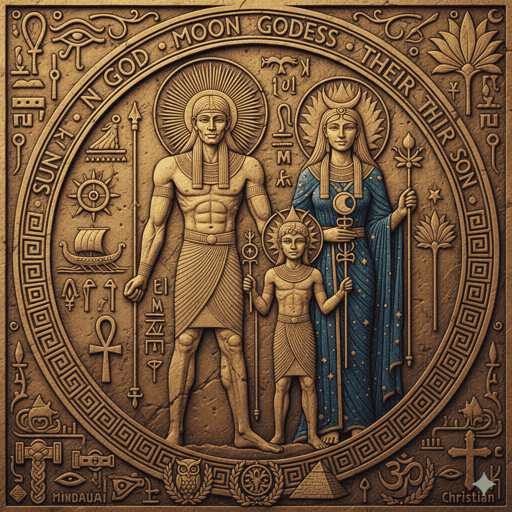
Since the dawn of civilization, every culture looked up at the sky — the Sun warming the day, the Moon ruling the night, and humanity living as a child in between.
And from this simple observation, a poetic structure appeared in countless mythologies:
☀️ The Sun — strength, power, creation
🌙 The Moon — mystery, cycles, emotion
👦 The Child — life on Earth, hero, savior
But while many mythologies follow this symbolic “Sun–Moon–Son” pattern, some do not — especially monotheistic faiths like Islam, which reject any divine family structure.
Let’s explore how different cultures imagined this cosmic trio.
🛕 1. Hinduism (Sanatan Dharma)
Hinduism does not present a literal Sun–Moon marriage, but uses solar & lunar symbolism deeply.
Sun (Male): Surya
Radiant, life-giving, father of heroes like Karna.
Moon (Male): Chandra / Soma
Associated with emotion, fertility, and the mind.
The Child?
Not literal — but reflected symbolically as:
- Rama from the Solar Dynasty (Suryavansh)
- Krishna from the Lunar Dynasty (Chandravansh)
Here the Sun and Moon represent lineages, not parents.
🏺 2. Greek Mythology
The Greeks built a clear celestial family.
Sun (Male): Helios / Apollo
Bearer of light.
Moon (Female): Selene / Artemis
Gentle, changing, mysterious.
Son:
The closest fit is the Titan family line:
- Hyperion (Father Sun)
- Theia (Mother Light)
- Helios (their Son – the Sun itself)
It’s a sky dynasty, not a savior.
🐆 3. Egyptian Mythology
Egypt had patterns similar to a divine family.
Sun (Male): Ra / Amun-Ra
Creator, supreme ruler.
Moon (Male): Thoth / Khonsu
Not female — but associated with cycles and wisdom.
The Son: Horus
Not a Sun–Moon child, but the classic divine son of:
- Osiris (father of order)
- Isis (mother, linked to lunar cycles)
Horus becomes the “child of light,” restoring justice.
🐉 4. Chinese Mythology
China gives one of the most literal Sun–Moon–Child patterns.
Sun (Female): Xihe
Mother of the Ten Suns.
Moon (Female/Male): Changxi (female) or Dijun (male)
Depending on the version.
Sons:
The Ten Suns, children of Xihe, who once rose together and burned the earth.
🔱 5. Norse Mythology (Odin, Thor Included)
Norse mythology presents a sky father, heroic son, and celestial symbolism — but NOT a Sun–Moon marriage.
Sky Father (Not Sun): Odin
All-father, ruler of wisdom.
Son (Heroic Child): Thor
God of thunder, protector of mankind.
Sun & Moon Deities:
- Sun (Female): Sól / Sunna
- Moon (Male): Máni
But Sól and Máni are siblings, not husband and wife, and Thor is not their child.
So the Norse version fits the celestial theme, but not the Sun–Moon–Son family structure.
Still, the pattern of:
Heavenly Father → Heroic Son → Celestial Forces
is strongly present.
✝️ 6. Christianity
Christianity uses celestial imagery symbolically.
Father: God the Father
Source of all light.
Mother (Symbolic): Mary
Often depicted standing on the Moon.
Son: Jesus Christ
Called “Light of the World.”
Not a Sun–Moon marriage — but a symbolic cosmic family.
✡️ 7. Judaism
No sun–moon gods, but symbolism exists:
- God = “Sun and Shield”
- Festivals follow the Moon
- Messiah = the awaited “child” of prophecy
Symbolic, not mythological.
🌙 8. Islam (Does NOT Fit the Pattern)
Islam stands completely outside of the Sun–Moon–Son theme.
In Islam:
- Allah has no parents, no partners, no children.
- The Sun and Moon are signs, not gods.
- Associating family with God is strictly rejected (Shirk).
- The awaited savior (Imam Mahdi A.S.) is not a divine son — just a righteous human leader.
So Islam must be placed in a separate category:
Pure monotheism without celestial family structures.
☸️ 9. Buddhism
Buddhism uses symbolic Sun–Moon imagery:
- Buddha = “Sun of Wisdom”
- Tara = associated with the Moon
- Maitreya = future “child of hope”
But again — symbolic, not literal.
🌀 Why These Patterns Appear Everywhere
Humanity grew under:
- one Sun
- one Moon
- one sky
So people naturally created stories reflecting:
- day and night
- life and death
- parent and child
- light and darkness
But each culture shaped the pattern differently based on values and worldview.
📊 Updated Comparison Table (Including Norse & Islamic Clarification)
| Hinduism | Surya | Chandra (male) | Rama / Krishna (dynasties) | Partially (symbolic) |
| Greek | Helios / Apollo | Selene / Artemis | Helios (as Titan child) | Yes (mythic lineage) |
| Egyptian | Ra | Thoth / Khonsu | Horus (child of Isis–Osiris) | Partially |
| Chinese | Xihe | Changxi / Dijun | Ten Suns | Yes (literal) |
| Norse | Sól | Máni | Thor (son of Odin) | No (different family) |
| Christianity | God (symbolic Sun) | Mary (Moon symbolism) | Jesus | Symbolic only |
| Judaism | God | Moon calendar | Messiah | Symbolic only |
| Islam | (Allah is One) | No wife | (no son) | ❌ Does NOT fit |
| Buddhism | Buddha = Sun symbolism | Tara | Maitreya | Symbolic |
| Zoroastrian | Ahura Mazda | Anahita | Saoshyant | Symbolic |
🌟 Final Question: Does This Mean One Religion Is True and Others False?
This is a philosophical question, and people answer it differently.
Some believe
The similarities mean all religions come from one original truth.
Others believe
Cultures simply created similar stories from the same sky above them.
And many believe
Each tradition holds a piece of humanity’s shared spiritual search.
What we can say with certainty is:
The Sun and Moon were humanity’s first teachers, and their light shaped our earliest stories.
The “Sun–Moon–Son” pattern is not proof of one religion nor dismissal of others —
it is a mirror of our shared human imagination, our fascination with the heavens, and our longing to explain existence.

Comments (0)
Leave a Reply
Log in to post a comment.