

 Jun 17, 2026
 4 min read
The Unseen Thirst: How Dehydration Silently Erodes Your Spinal Health
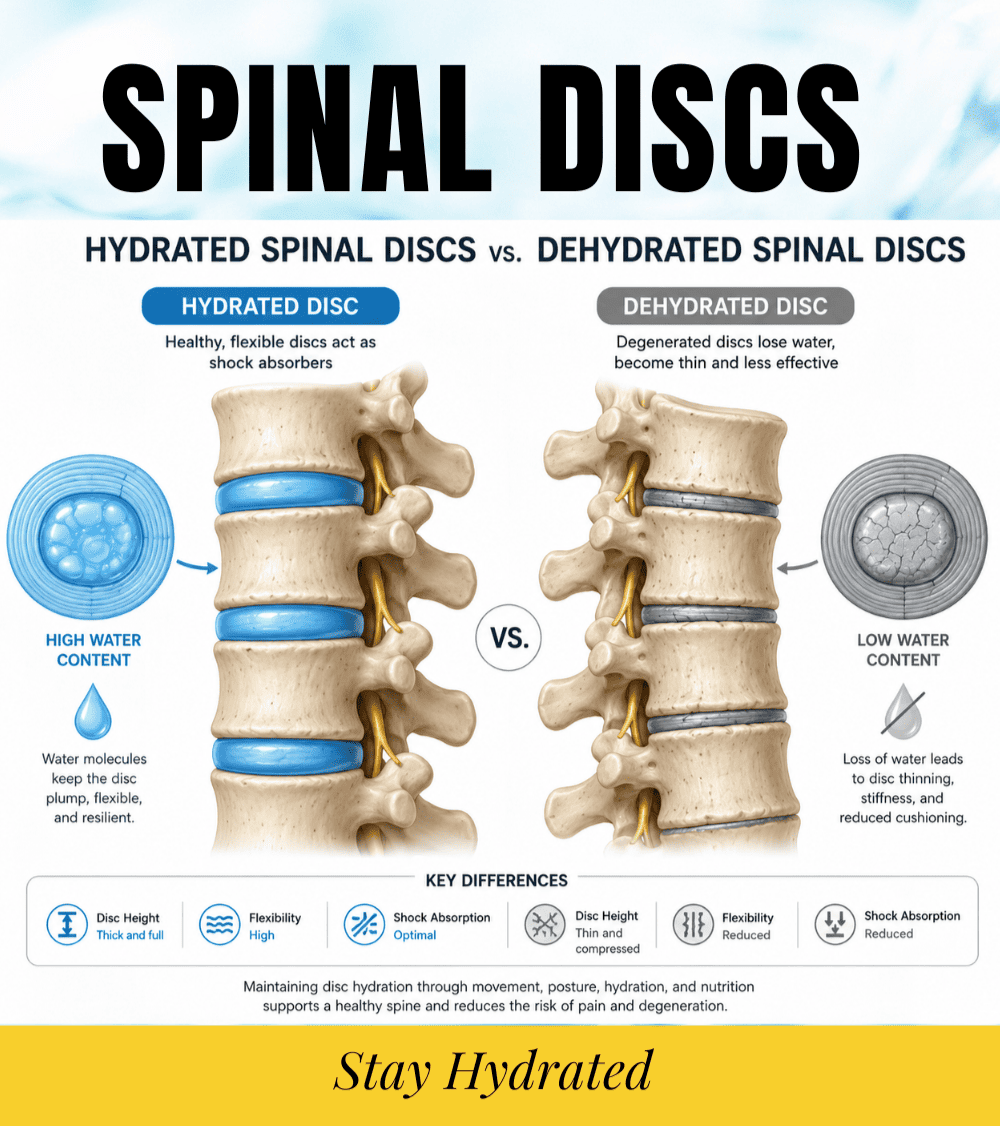
The Unseen Thirst: How Dehydration Quietly Affects Your Spinal Health
We all understand the importance of drinking enough water for overall health – it helps keep your skin looking good, gives you energy in the morning, and supports the proper functioning of your organs.
However, one of the quiet, often ignored effects of long-term dehydration is its impact on your spinal discs.These important parts of your back, which help you bend, twist, and move smoothly, can be seriously affected by not getting enough fluids.
Think of your spinal discs like small, delicately designed jelly donuts.
The outer part, called the annulus fibrosus, is a strong, fibrous covering.The inner part, known as the nucleus pulposus, is a soft, gel-like core made mostly of water and special proteins called proteoglycans.This inner part is essential for absorbing shocks and allowing your spine to move freely.
Can Dehydration Lead to Back Pain or Spine Problems?
The connection between dehydration and your back lies in the structure and function of your spine.
Water plays an unexpected but critical role in maintaining the health of your spine.How your body moves, how it absorbs water, and your overall hydration levels all influence how easily you can move without pain.
The Chain Reaction of Dehydration:
So what happens when you don't drink enough water?
1.Softening of the Inner Jelly:
The nucleus pulposus is very water-loving.It draws water in to keep it firm and capable of absorbing shocks.When you are dehydrated, this core loses its water content and starts to shrink.It becomes less dense and less effective at cushioning the bones in your spine.Imagine a flat tire – it can't handle bumps as well.
2. Loss of Spinal Height and Flexibility:
As the discs lose their fluid, their height decreases.This small change has big effects.The vertebrae come closer together, increasing pressure on the nerves that exit the spine.Also, the discs become less flexible, making movements feel stiff and more likely to cause strain.
3.Increased Wear and Tear:
Hydrated discs act like springs, spreading forces evenly across the surface.But when they're dehydrated and shrunk, they don’t distribute forces as smoothly.This damage puts more pressure on certain parts of the annulus fibrosus, making it more likely to tear or wear down.Over time, this speeds up the natural aging of the spine, leading to conditions like osteoarthritis.
4.Impaired Nutrient Supply:
Spinal discs do not have their own blood supply.Instead, they get nutrients and remove waste by soaking up fluids from the surrounding area, a process called imbibition.Dehydration slows this process, depriving the disc cells of the nourishment they need to stay healthy.This contributes even more to the disc’s deterioration.
5.Risk of Bulging or Herniated Discs:
Although dehydration isn’t the only cause of disc issues, it can significantly increase the risk.A dry disc is weaker, with the inner jelly not contained as well and the outer ring losing some strength.This makes the disc more prone to bulge under normal stress, and in severe cases, the jelly can push through the outer layer, causing a herniated disc that leads to pain.
Recognizing the Signs:
The effects of dehydration on your spine can be hard to notice at first.
The early symptoms may be mild or overlooked, but they are important to watch for.
Watch for these warning signs:
- - Stiffness in the back
- - Weakness in the leg muscles
- - Mild back pain or a general feeling of creakiness
- - Bulging areas on the spine
- - Weak reflexes in the legs
- - Dry mouth
- - Low blood pressure
- - Dark-colored urine
- - Dizziness
If you notice these symptoms and are not drinking enough water, it’s worth considering that dehydration could be a contributing factor.
The Simple Fix:
The good news is that you can prevent and even reverse some of the damage caused by dehydration to your spinal discs.
The solution is simple: drink more water.Aim for at least eight glasses (about 2 liters) a day, and more if you're physically active or in a hot environment.Pay attention to your body – thirst is a sign that you're already slightly dehydrated.
Here are some helpful tips to help maintain hydration and support the health of your spinal discs:
- - Eat fruits and vegetables, as they also contain water.
- - Check the color of your urine regularly.
- - Aim to drink 30 to 50 ounces or 1 to 1.5 liters of water each day.
- - Take sips throughout the day instead of drinking large amounts at once.
- - Limit drinks that make you urinate more quickly, such as coffee, tea, alcohol, and soda.
- - Drink more water when you're exercising or in a hot climate.
In addition to water, making sure you eat plenty of water-rich fruits and vegetables also helps keep your body well-hydrated.
Maintaining proper hydration not only helps you feel better today, but it also helps protect your mobility and comfort in the future.So, the next time you reach for a drink, remember that you're not just quenching your thirst—you're also supporting the foundation of your movement.




Comments (0)
Leave a Reply
Log in to post a comment.